Logistic Function for Transition Between Reproduction Numbers
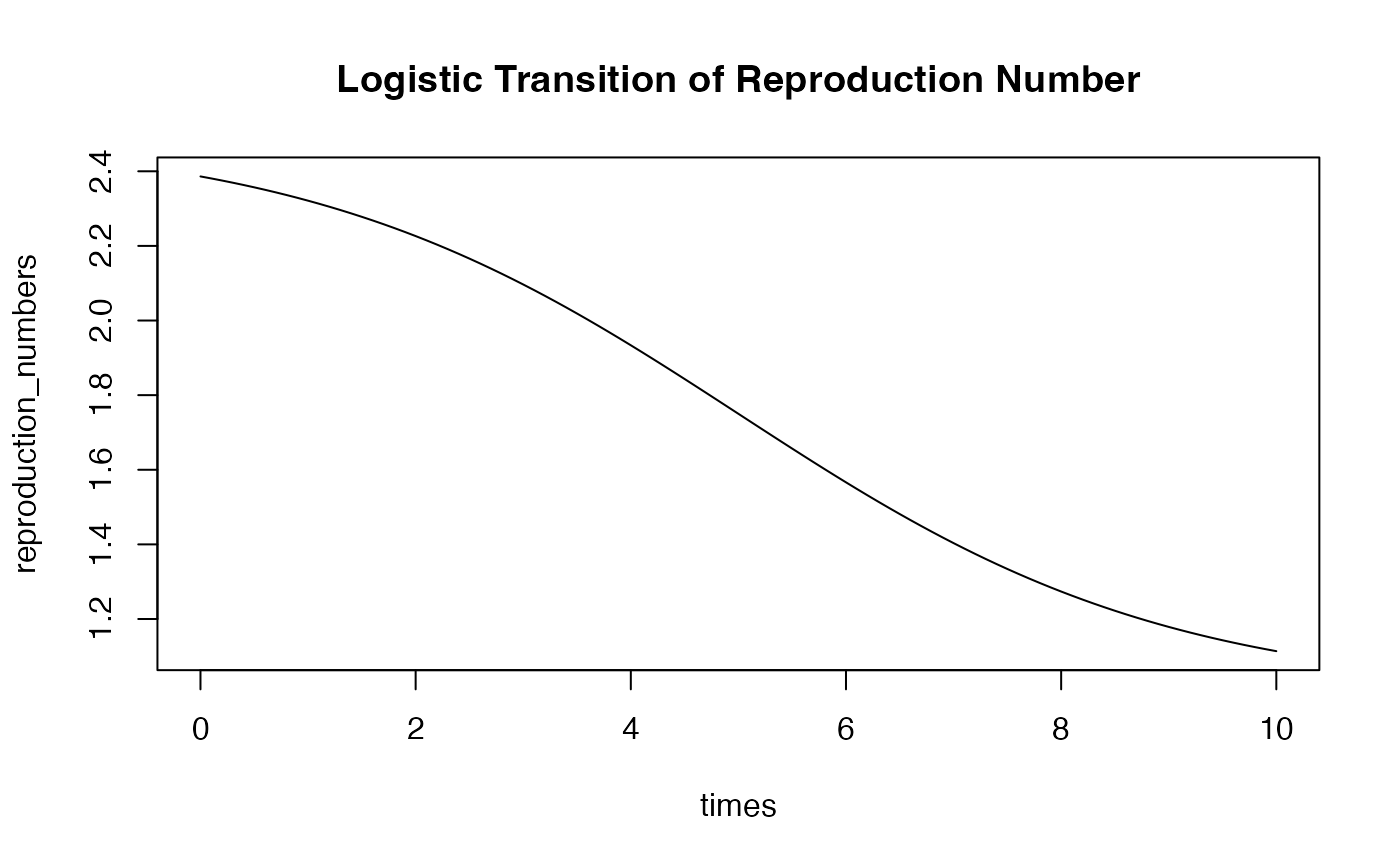
logistic_function.RdThis function models a smooth transition between two reproduction numbers (\(R_0\) and \(R_1\)) over time using a logistic curve.
Arguments
- t
A numeric value or vector representing the time point(s) at which to calculate the reproduction number.
- R0
A numeric value representing the initial reproduction number (\(R_0\)).
- R1
A numeric value representing the final reproduction number (\(R_1\)).
- r
A numeric value representing the growth rate or steepness of the logistic transition.
- t0
A numeric value representing the midpoint of the transition where the reproduction number is halfway between \(R_0\) and \(R_1\).